
Modern data centers are becoming more complex every year. A single facility may contain hundreds or thousands of servers, network devices, racks, UPS systems, PDUs, cooling units, environmental sensors, power circuits, and supporting infrastructure.
The challenge is not simply keeping all of this equipment running.
The bigger challenge is understanding what is happening across the entire physical infrastructure.
How much power is available in a rack?
Which devices are consuming that power?
Is there enough cooling capacity for new equipment?
Which rack still has usable space?
Are both A and B power feeds operating normally?
Which assets are approaching capacity limits?
Where is the temperature increasing?
Can another server be installed without creating a power, cooling, or space problem?
These questions become difficult to answer when information is spread across spreadsheets, monitoring platforms, facility systems, network tools, and manual records.
This is where Data Center Infrastructure Management (DCIM) becomes important.
DCIM brings information about physical data center infrastructure into a more centralized management environment. It helps operations teams understand assets, power, cooling, environmental conditions, capacity, and infrastructure relationships so they can make better operational decisions.
However, DCIM should not be viewed as just another monitoring dashboard.
A useful DCIM implementation connects software visibility with the real physical infrastructure inside the data center.
This guide explains what DCIM is, how it works, what problems it can solve, where its data comes from, and why successful DCIM implementation depends on much more than installing software.
Table of Contents
What Is DCIM?
DCIM stands for Data Center Infrastructure Management.
It refers to software, tools, processes, and integrations used to monitor and manage the physical infrastructure of a data center.
A DCIM platform can bring together information related to:
- Racks and cabinets
- Servers
- Network equipment
- Storage systems
- UPS systems
- Power distribution units
- Rack PDUs
- Cooling equipment
- Temperature and humidity sensors
- Power circuits
- Rack capacity
- Energy consumption
- Asset location
- Environmental conditions
- Infrastructure capacity
The exact capabilities depend on the DCIM platform and how it has been implemented.
At a basic level, DCIM creates better visibility into the physical data center.
At a more advanced level, it can help teams understand relationships between assets, power, cooling, rack space, connectivity, capacity, and environmental conditions.
This allows data center teams to move from simply reacting to infrastructure problems toward making decisions based on actual operational data.
Why Is Data Center Infrastructure Management Important?
Small IT environments can often be managed using spreadsheets, equipment labels, monitoring tools, and the knowledge of individual engineers.
This approach becomes increasingly difficult as the infrastructure grows.
Consider a data center containing hundreds of racks.
Each rack may contain servers, switches, storage equipment, intelligent rack PDUs, power feeds, network connections, and environmental sensors.
Now imagine that a new server must be installed.
Finding an empty rack unit is only the beginning.
The engineer may also need to know:
- How much power capacity remains in the rack?
- Is the available capacity sufficient on both A and B feeds?
- Will the additional equipment increase the rack beyond an acceptable power threshold?
- Is cooling adequate at that location?
- Are the required network connections available?
- Which upstream PDU or power circuit supplies the rack?
- Is the rack already approaching a capacity limit?
Without centralized infrastructure information, answering these questions can involve several systems and sometimes a physical visit to the data center floor.
DCIM attempts to bring this information together.
The goal is not simply to create another screen full of graphs.
The goal is to make infrastructure information useful for real operational decisions.
The Difference Between Monitoring and Infrastructure Management
One common misunderstanding is that DCIM is simply another monitoring system.
Monitoring is certainly an important part of DCIM, but DCIM can go beyond monitoring.
A traditional monitoring system might tell an engineer:
Rack PDU load: 4.8 kW
That information is useful.
But an infrastructure management platform may provide additional context:
- Which rack contains the PDU
- Which equipment is installed in that rack
- What the rack’s expected capacity is
- How much capacity remains
- Which upstream power source supplies it
- Whether another planned device can safely be installed
- How the rack relates to other physical infrastructure
The difference is context.
Monitoring tells you what a device is reporting.
Infrastructure management helps explain what that information means within the wider data center environment.
Core Functions of DCIM
Different DCIM products offer different capabilities, but most platforms focus on several common areas.
1. Asset Management
A data center contains many physical assets.
These can include:
- Servers
- Network switches
- Routers
- Firewalls
- Storage systems
- Racks
- UPS systems
- PDUs
- Rack PDUs
- Cooling equipment
- Sensors
Keeping an accurate record of these assets becomes difficult as equipment is installed, moved, replaced, or retired.
DCIM can maintain information such as:
- Asset name
- Manufacturer
- Model
- Serial number
- Rack location
- Rack unit position
- Power connections
- Network relationships
- Installation date
- Asset status
This creates a structured view of the physical environment.
The value of this information depends heavily on accuracy.
If equipment is physically moved but the DCIM database is not updated, the system slowly stops representing the real data center.
For this reason, asset management is not only a software function. It is also an operational process.
2. Rack and Space Management
Rack space is one of the most visible data center resources.
A DCIM platform can provide a graphical or logical representation of racks and show where equipment is installed.
Instead of physically checking each cabinet, an engineer may be able to see:
- Occupied rack units
- Available rack units
- Reserved space
- Installed equipment
- Rack power consumption
- Rack capacity
- Equipment dimensions
But available rack units do not automatically mean usable capacity.
A rack may have 10U of physical space available but insufficient power or cooling for the proposed equipment.
Proper rack planning starts before equipment is installed. Our Data Center Rack Installation: 15 Essential Checks Before Installation guide covers the key physical infrastructure checks to consider before deploying equipment in a rack.
This is why effective capacity management must consider more than physical space.
3. Power Monitoring
Power is one of the most important resources in any data center.
DCIM can collect power-related information from devices such as:
- UPS systems
- PDUs
- Intelligent rack PDUs
- Power meters
- Branch circuit monitoring systems
Depending on the hardware and integration, information may include:
- Voltage
- Current
- Power consumption
- Energy usage
- Load percentage
- Circuit utilization
- PDU utilization
- Rack-level power consumption
This information can help engineers identify overloaded circuits, underutilized infrastructure, abnormal consumption, and available capacity.
Power monitoring becomes particularly useful when the data is connected to physical assets and rack locations.
Instead of seeing only that a PDU is operating at a certain load, teams can understand which racks and equipment contribute to that load.
4. Environmental Monitoring
Temperature and humidity can significantly affect data center reliability.
Environmental sensors may be installed:
- At rack fronts
- At rack rears
- At the top or bottom of racks
- In hot aisles
- In cold aisles
- Around critical infrastructure
DCIM can collect this sensor data and provide centralized visibility.
Depending on the environment, monitoring may include:
- Temperature
- Humidity
- Water leakage
- Airflow
- Differential pressure
- Door status
- Smoke or other environmental conditions
This can help teams identify developing problems before they become major infrastructure incidents.
For example, the average room temperature may appear normal while one group of high-density racks experiences elevated inlet temperatures.
Room-level information alone may not reveal this problem.
Rack-level environmental monitoring can provide much better visibility.
5. Cooling Visibility
Cooling represents a major part of data center infrastructure.
DCIM can help teams understand cooling conditions and, depending on integration, may receive information from systems such as:
- CRAC units
- CRAH units
- Chillers
- Cooling distribution equipment
- Environmental sensors
- Building management systems
The purpose is not necessarily to replace the control system responsible for cooling.
Instead, DCIM can provide additional infrastructure context.
For example, teams may be able to compare equipment density, rack power, and temperature conditions in the same environment.
This can help identify hot spots, cooling inefficiencies, or areas where capacity planning requires additional attention.
6. Capacity Management
Capacity management is one of the strongest use cases for DCIM.
Data center capacity is not defined by a single number.
Real capacity may depend on several resources at the same time:
Space + Power + Cooling + Connectivity + Supporting Infrastructure
A rack may have physical space available but no sufficient power.
Another rack may have power capacity but insufficient cooling.
Another location may have both, but the required network connectivity may not be available.
Therefore, useful capacity management should answer more than:
“Where is there an empty rack unit?”
It should help answer:
“Where can this equipment actually be deployed safely and efficiently?”
This distinction is extremely important in real data center operations.
Where Does DCIM Get Its Data?
This is one of the most important parts of understanding DCIM.
A dashboard does not automatically know what is happening inside a data center.
The information has to come from somewhere.
DCIM platforms can receive information from multiple sources, including:
- UPS systems
- Intelligent PDUs
- Rack PDUs
- Environmental sensors
- Power meters
- Cooling systems
- Building management systems
- Network management platforms
- Asset databases
- APIs
- Manually maintained records
Communication can involve technologies and protocols such as:
- SNMP
- Modbus
- BACnet
- REST APIs
- Vendor-specific interfaces
The exact architecture varies between environments.
A simplified information flow may look like this:
Physical Infrastructure → Sensors and Intelligent Devices → Network/Communication Protocols → DCIM Platform → Dashboard, Analytics and Alerts
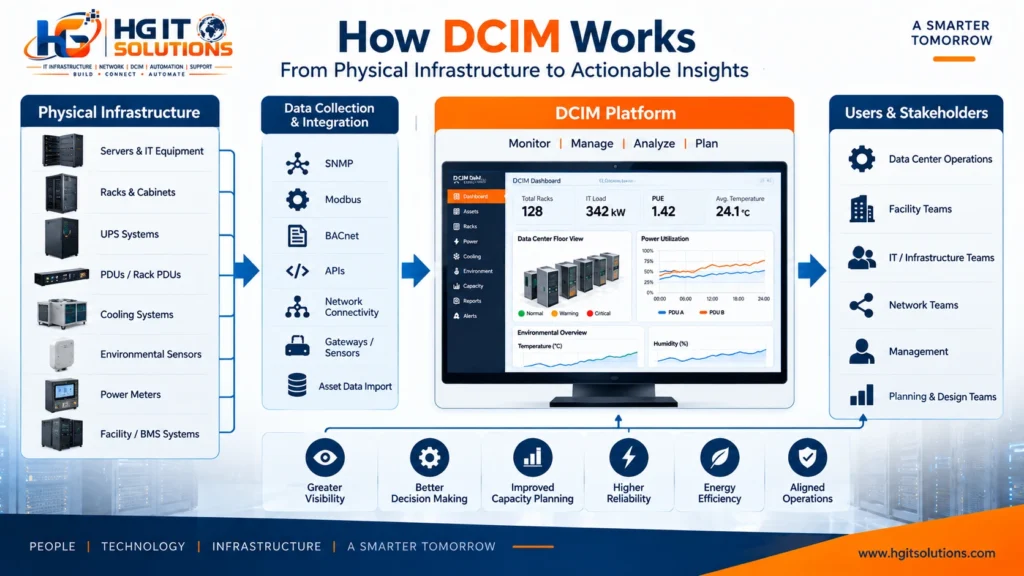
This is why DCIM cannot be separated from the physical infrastructure underneath it.
If a sensor is incorrectly installed, the data can be misleading.
If a PDU is not reachable over the management network, data collection may stop.
If device mapping is incorrect, information may be associated with the wrong asset.
If an asset database is outdated, capacity calculations may be inaccurate.
The quality of the DCIM output depends heavily on the quality of its input.
DCIM Is Not Just Software
This is where many DCIM discussions become too software-focused.
A DCIM product may provide an excellent interface, attractive dashboards, reports, alarms, and capacity calculations.
But the platform still depends on the infrastructure underneath it.
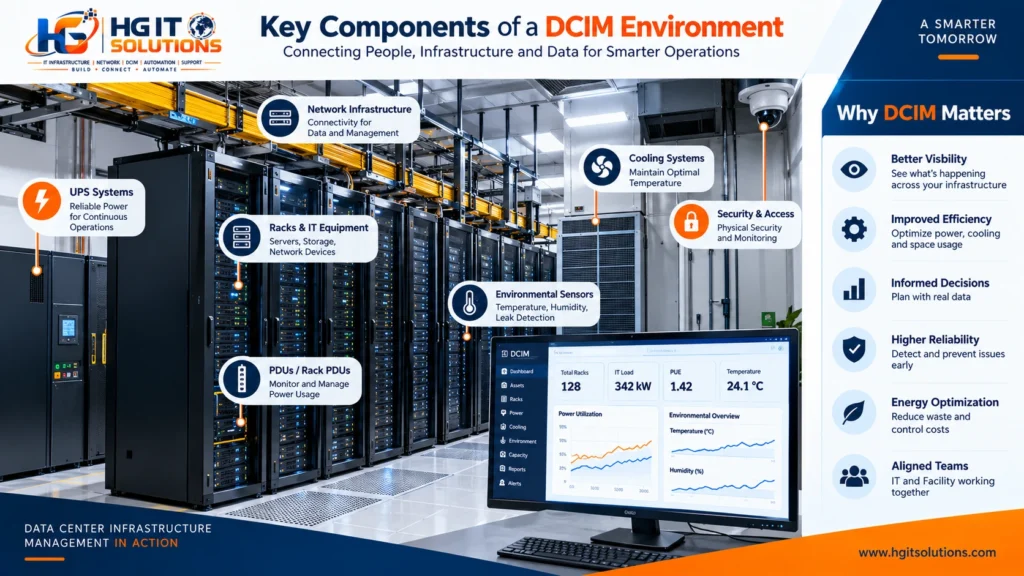
A practical DCIM environment can involve several layers:
Physical equipment
Servers, racks, UPS systems, PDUs, cooling equipment and other infrastructure.
Measurement layer
Power meters, intelligent PDUs and environmental sensors.
Communication layer
Ethernet networks, management networks, gateways and communication protocols.
Integration layer
APIs, SNMP, Modbus, BACnet and vendor integrations.
DCIM platform
Asset database, monitoring engine, capacity management, analytics and visualization.
Operational process
Engineers and facility teams maintaining accurate records and responding to information.
A problem at any layer can affect the final result.
This leads to an important practical principle:
DCIM visibility can only be as reliable as the infrastructure data feeding it.
A Real-World DCIM Example
Consider a simple scenario.
A company needs to install several new servers in an existing data center.
Without centralized infrastructure management, an engineer might begin by checking which racks have enough physical space.
Rack 24 has enough free rack units.
At first, it looks like the obvious location.
But further investigation shows that one of the rack power feeds is already operating close to the organization’s defined capacity threshold.
The engineer now checks Rack 31.
It has enough power capacity, but temperature data shows that the surrounding area is already operating warmer than nearby racks.
Rack 42 has enough physical space, adequate power on both feeds, acceptable temperature conditions, and the required network connectivity.
Rack 42 becomes a practical deployment option.
The important point is that rack space alone did not determine usable capacity.
Several infrastructure conditions had to be considered together.
A well-implemented DCIM environment can make this type of decision much easier.
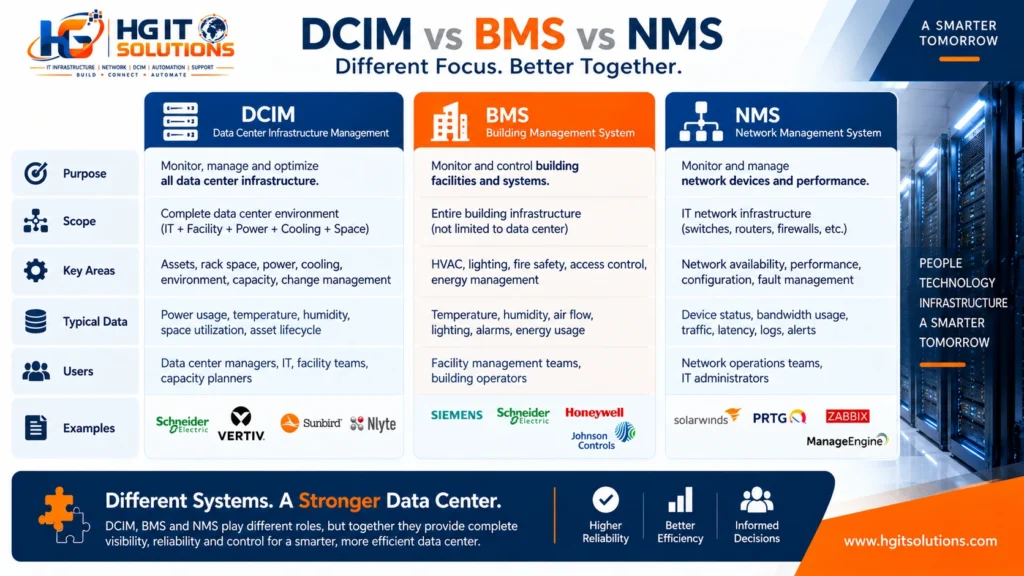
DCIM vs BMS vs NMS
DCIM is sometimes confused with BMS and NMS platforms.
They can overlap in certain areas, but they generally serve different purposes.
Building Management System (BMS)
A BMS is commonly used to monitor and control building and facility systems.
This may include:
- HVAC
- Chillers
- Pumps
- Electrical systems
- Building alarms
- Facility sensors
The BMS is closely connected to facility operations and control.
Network Management System (NMS)
An NMS focuses primarily on network infrastructure.
It may monitor:
- Switches
- Routers
- Firewalls
- Network interfaces
- Bandwidth
- Device availability
- Network performance
Data Center Infrastructure Management (DCIM)
DCIM focuses on the relationship between physical data center assets, capacity, power, environment, space, and supporting infrastructure.
In many modern environments, these systems do not need to operate in isolation.
A DCIM platform may receive information from a BMS, NMS, or other systems through supported integrations.
The goal should not be to duplicate every function.
The goal is to provide useful infrastructure visibility across systems.
The Market Gap: Dashboards Are Not the Whole Solution
The DCIM market contains many capable platforms.
However, much of the discussion around DCIM naturally focuses on software features.
Screenshots often show:
- Colorful dashboards
- Rack visualizations
- Capacity graphs
- Energy reports
- Temperature maps
- Asset inventories
These capabilities are valuable, but they show only the visible part of a DCIM environment.
The less visible work happens underneath.
Before a dashboard can display accurate information, someone has to determine:
- Which devices should be monitored
- How they will communicate
- Which protocols are available
- How management connectivity will be provided
- Where environmental sensors should be installed
- How racks and assets will be identified
- How power relationships will be mapped
- How asset changes will be maintained
- Who owns the accuracy of the data
This creates a gap between buying a DCIM product and building a reliable DCIM system.
Software licensing does not automatically solve poor asset records, missing sensors, inaccessible devices, inconsistent naming, network communication problems, or incorrect infrastructure mapping.
These details may not look impressive in a product demonstration, but they often determine whether the implementation becomes useful.
Common DCIM Implementation Challenges
Inaccurate Asset Information
One of the biggest problems is outdated asset data.
If equipment is moved, removed, or replaced without updating the DCIM system, trust in the platform decreases.
Once engineers stop trusting the data, they start physically verifying everything again.
At that point, much of the value of DCIM is lost.
Poor Device Integration
Not every infrastructure device exposes information in the same way.
Different vendors may support different protocols, data models, firmware capabilities, and integration methods.
Older equipment may provide limited monitoring.
Integration therefore needs to be planned rather than assumed.
Network Connectivity Problems
Many intelligent infrastructure devices require network connectivity.
That means DCIM can indirectly depend on:
- Management VLANs
- IP addressing
- Routing
- Firewalls
- DNS
- SNMP configuration
- Authentication
- Network availability
A DCIM engineer may therefore need to understand both facility infrastructure and networking.
This is one reason DCIM often sits between traditional IT and facility engineering.
Incorrect Sensor Placement
Installing a temperature sensor does not automatically provide meaningful temperature information.
Sensor location matters.
A sensor placed in the wrong position may produce technically accurate measurements that do not represent the condition the team actually wants to monitor.
Physical installation quality is therefore part of monitoring quality.
Lack of Operational Process
Even a technically successful DCIM deployment can become inaccurate over time if operational processes are weak.
For example:
A server is moved from Rack A to Rack B.
The physical work is completed correctly.
But nobody updates the DCIM platform.
The system now contains incorrect information.
Organizations therefore need processes that keep physical changes and digital records synchronized.
DCIM and Energy Efficiency
Energy efficiency is another important DCIM use case.
Data centers consume power not only for IT equipment but also for cooling, power conversion, lighting, and supporting infrastructure.
DCIM can help teams understand where energy is being consumed and identify trends.
Depending on available data, teams may analyze:
- Facility power consumption
- IT load
- Rack-level consumption
- PDU utilization
- UPS loading
- Historical energy trends
One commonly discussed data center efficiency metric is Power Usage Effectiveness (PUE).
PUE compares total facility energy with the energy consumed by IT equipment.
However, a metric should not be treated as the entire efficiency strategy.
A single number does not explain every operational condition inside a data center.
Useful energy management requires reliable measurements, correct context, and an understanding of what is actually driving consumption.
DCIM and Data Center Planning
DCIM can also help with future planning.
Suppose a data center appears to have significant physical rack space available.
Management may assume that additional equipment can continue to be installed.
But DCIM data may show that available electrical capacity is decreasing much faster than rack space.
In that case, the true constraint is power rather than floor or rack space.
Another facility may have enough electrical capacity but face cooling limitations in specific areas.
Understanding the actual limiting resource can help organizations make better infrastructure investment decisions.
This is where historical DCIM data can become valuable.
The system is no longer showing only what exists today.
It can help teams understand how infrastructure is being consumed over time.
Who Uses DCIM?
DCIM information can be useful to several teams.
Data Center Operations
For rack management, asset tracking, capacity planning and day-to-day operations.
Facility Teams
For power, cooling, environmental conditions and facility infrastructure.
Network Teams
For management connectivity and relationships between network infrastructure and physical assets.
IT Infrastructure Teams
For server deployment, equipment planning and asset lifecycle management.
Management
For capacity planning, utilization, efficiency and infrastructure investment decisions.
One of the potential strengths of DCIM is creating a common infrastructure view across teams that traditionally use separate tools.
What Should Organizations Consider Before Implementing DCIM?
The first question should not necessarily be:
“Which DCIM software should we buy?”
A better starting point is:
“What infrastructure problem are we trying to solve?”
For one organization, the priority may be asset management.
For another, it may be power capacity.
Another may need environmental monitoring.
A large colocation facility may have completely different requirements from a small enterprise data center.
Before selecting a platform, organizations should understand:
- Current infrastructure
- Existing monitoring systems
- Available sensors
- Device communication capabilities
- Asset data quality
- Network requirements
- Integration requirements
- Capacity planning goals
- Reporting requirements
- Operational workflows
Technology selection becomes easier when the operational requirements are clear.
Commercial and Open-Source DCIM
The DCIM ecosystem includes commercial platforms as well as open-source tools and infrastructure management projects.
Commercial solutions may offer integrated support, vendor integrations, visualization, reporting, capacity planning, automation, and enterprise features.
Open-source platforms can provide flexibility, transparency, and strong infrastructure documentation capabilities depending on the project and use case.
Neither category should automatically be considered suitable for every environment.
The right approach depends on factors such as:
- Data center size
- Technical requirements
- Existing infrastructure
- Available engineering skills
- Integration requirements
- Automation goals
- Support expectations
- Budget
- Long-term maintenance
Commercial versus open-source DCIM is a much larger subject and deserves its own detailed discussion.
The Future of Data Center Infrastructure Management
Data centers continue to change.
Higher rack densities, accelerated computing, AI workloads, liquid cooling, intelligent power equipment, automation, APIs, and increasingly detailed telemetry are changing the information infrastructure teams need.
DCIM platforms are also evolving.
Future data center management is likely to depend increasingly on:
- Real-time telemetry
- APIs
- Automation
- Historical analytics
- Capacity forecasting
- Energy optimization
- More detailed environmental monitoring
- Integration between IT and facility systems
Artificial intelligence may also help analyze infrastructure data and identify patterns that are difficult to detect manually.
But advanced analytics still depend on a basic requirement:
The underlying data must be trustworthy.
AI cannot correct a physical asset that was never recorded properly.
Analytics cannot compensate for a temperature sensor installed in the wrong location.
Capacity forecasting cannot be reliable if equipment moves are not documented.
The fundamentals remain important.
The HG IT Solutions Perspective: From Infrastructure to Visibility
At HG IT Solutions, we believe useful data center management begins with understanding the physical infrastructure.
Software is important, but software is only one layer.
Behind every dashboard value there is usually something physical:
A sensor.
A power meter.
A UPS.
A PDU.
A network connection.
A cooling unit.
A server.
A rack.
And behind those devices are the cabling, communication protocols, configurations, integrations, and operational processes that make their information available.
This is the area we want to explore in depth through the HG IT Solutions Blog.
Rather than discussing DCIM only from a software feature perspective, our goal is to connect the dashboard with what actually exists on the data center floor.
Future articles in this series will explore topics such as DCIM architecture, sensors, power monitoring, communication protocols, commercial platforms, open-source solutions, deployment methods, integrations, configuration, troubleshooting, and real-world infrastructure scenarios.
The objective is simple:
Understand not only what DCIM shows, but how the complete system works underneath it.
Final Thoughts
Data Center Infrastructure Management (DCIM) is much more than a graphical representation of racks.
A well-designed DCIM environment can connect information about assets, power, cooling, environment, space, and capacity to provide a clearer picture of data center operations.
But purchasing software alone does not create that visibility.
Reliable DCIM depends on reliable physical infrastructure, appropriate sensors, working communication networks, correct integrations, accurate asset information, and disciplined operational processes.
This is also where one of the biggest opportunities in DCIM exists.
The industry has powerful software platforms and increasingly intelligent infrastructure equipment. The challenge is connecting these layers correctly and maintaining accurate information throughout the life of the data center.
When that foundation is built properly, DCIM can move beyond being another monitoring dashboard.
It can become an operational tool that helps engineers answer one of the most important questions in data center management:
What is really happening inside our infrastructure, and what can we safely do next?
Frequently Asked Questions About DCIM
What does DCIM stand for?
DCIM stands for Data Center Infrastructure Management. It refers to tools and processes used to monitor and manage physical data center infrastructure such as racks, power systems, cooling, environmental conditions, assets, and capacity.
Is DCIM a monitoring tool?
Monitoring is part of DCIM, but DCIM can provide additional infrastructure context including asset relationships, rack space, capacity, power distribution, and physical locations.
What equipment can DCIM monitor?
Depending on the platform and integrations, DCIM may receive information from UPS systems, PDUs, intelligent rack PDUs, environmental sensors, cooling systems, power meters, servers, and other infrastructure devices.
What protocols are commonly used with DCIM?
DCIM integrations may use protocols and interfaces such as SNMP, Modbus, BACnet, REST APIs, and vendor-specific communication methods.
What is the difference between DCIM and BMS?
A BMS primarily manages building and facility systems, while DCIM focuses on data center infrastructure, assets, capacity, power, space, and environmental visibility. The two systems can also exchange information through integrations.
What is the difference between DCIM and NMS?
An NMS primarily monitors network devices and network performance. DCIM focuses more broadly on the physical data center environment, including racks, assets, power, cooling, environmental conditions, and capacity.
Can DCIM help reduce data center energy consumption?
DCIM can provide energy and power consumption visibility that helps teams identify utilization patterns and potential inefficiencies. Actual savings depend on how the information is used and what infrastructure changes are made.
Is DCIM only for large data centers?
No. DCIM concepts can also be useful in smaller environments. However, the complexity and cost of the solution should match the size and operational requirements of the facility.
Is open-source DCIM available?
Yes. Open-source infrastructure management and documentation platforms exist, although capabilities vary considerably between projects. Organizations should evaluate them based on their specific monitoring, asset, integration, automation, and support requirements.
Does installing DCIM software automatically discover everything in a data center?
Not necessarily. Some information can be discovered or imported, but accurate DCIM often requires device integration, asset mapping, sensor deployment, network configuration, data validation, and ongoing operational maintenance.
What is the most important requirement for successful DCIM?
There is no single requirement, but accurate and trustworthy infrastructure data is fundamental. A sophisticated platform cannot provide reliable decisions when the information feeding it is incomplete or incorrect.

Pingback: Data Center Asset Naming: A Practical Naming Convention